| Conductor material |
Annealed copper for general power and control wiring |
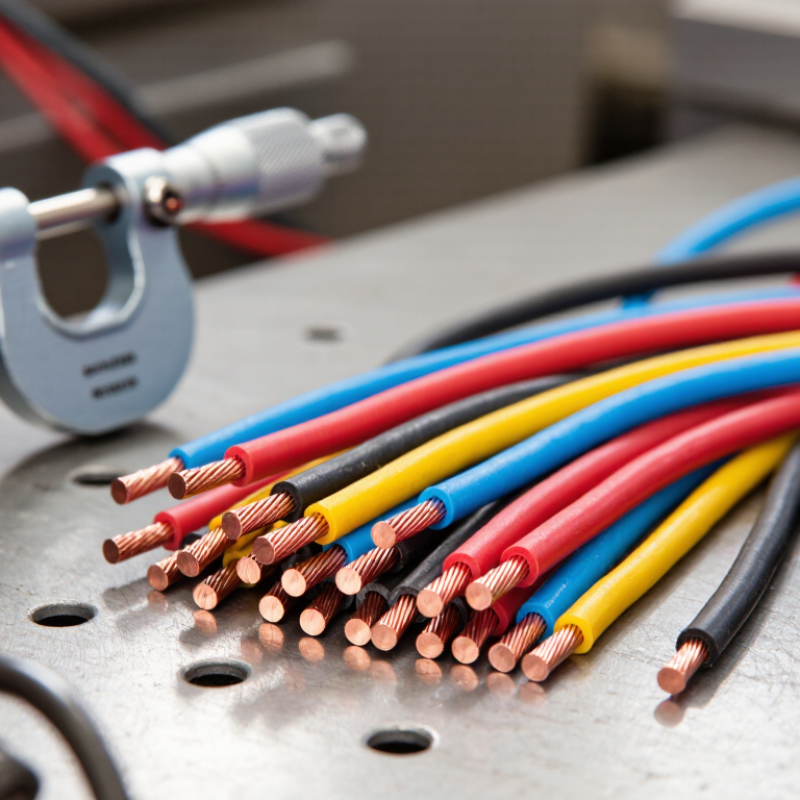
Copper provides high conductivity and is commonly specified for flexible or fixed single-core cables. |
Conductor material declaration, incoming-material inspection records, and conductor resistance test results. |
Choose copper when low voltage drop, reliable crimping, and long-term electrical stability are priorities. |
| Conductor class |
IEC 60228 Class 1 or Class 2 for fixed installation; Class 5 for flexible applications |
Class 1 uses a solid conductor, while Classes 2 and 5 use stranded conductors with increasing flexibility. |
Construction drawing, strand count, individual strand diameter, and applicable conductor-class test report. |
Use solid wire for permanent fixed routing and stranded wire where repeated movement or easier installation is required. |
| Typical insulation |
PVC insulation for ordinary indoor wiring; low-smoke, halogen-free materials for specialized environments |
PVC is widely used because it offers economical insulation, mechanical protection, and a typical continuous conductor temperature of 70°C for common 70°C wire designs. |
Insulation material specification, temperature rating, flame test results, and thickness measurement records. |
Do not select by price alone; confirm temperature, flame, smoke, and chemical-resistance requirements for the installation. |
| Common conductor sizes |
1.5 mm², 2.5 mm², 4 mm², and 6 mm² |
These sizes are commonly used for lighting, socket circuits, control wiring, and moderate power distribution, subject to local electrical codes. |
Cross-sectional-area measurement, conductor diameter or strand construction data, and finished-cable inspection report. |
Select the size from the required current, installation method, ambient temperature, voltage drop, and permissible protection device. |
| Maximum DC resistance at 20°C |
Values consistent with IEC 60228 conductor requirements |
Typical maximum values for annealed copper conductors:
1.5 mm²: 12.1 Ω/km
2.5 mm²: 7.41 Ω/km
4 mm²: 4.61 Ω/km
6 mm²: 3.08 Ω/km
|
Laboratory resistance report showing conductor size, test temperature, measured resistance, and correction method. |
Lower measured resistance generally indicates better electrical performance, provided the conductor size and material are genuine. |
| Voltage rating |
450/750 V for common fixed-installation PVC-insulated wire designs |
The selected voltage rating must match the system voltage and the applicable installation standard. |
Product datasheet, marking sample, dielectric-strength test report, and applicable standard declaration. |
Never use a lower-rated wire because the conductor size appears adequate; insulation voltage rating is a separate requirement. |
| Insulation resistance |
A result meeting the applicable product standard at the specified temperature and test voltage |
High insulation resistance reduces leakage risk and helps confirm consistent insulation quality. |
Routine test records, type-test report, test voltage, test temperature, and measured insulation resistance. |
Ask for results from the same construction and size being purchased rather than a generic report for another product. |
| ISO 9001 quality management |
A current ISO 9001 certificate covering cable or wire manufacturing |
ISO 9001 demonstrates that a quality-management system is in place; it does not by itself certify every wire specification. |
Current certificate, certificate scope, issuing certification body, validity dates, and audit status. |
Verify the certificate number and scope independently where possible, and confirm that production sites match the certificate. |
| RoHS compliance |
Compliance with the applicable RoHS substance restrictions |
Restricted substances commonly assessed include lead, mercury, cadmium, hexavalent chromium, PBB, PBDE, and specified phthalates. |
Recent material or finished-product test report using recognized methods such as IEC 62321, plus a material declaration. |
Check the report date, sample description, tested materials, laboratory identity, and whether the result applies to the actual insulation and sheath materials. |
| Test-report quality |
Traceable reports from a competent laboratory |
A useful report identifies the sample, standard, test method, date, measured results, acceptance criteria, and laboratory authorization. |
Complete report rather than a single-page certificate or marketing summary; verify laboratory accreditation when required. |
Reject reports with unclear sample descriptions, expired dates, missing signatures, or results unrelated to the ordered construction. |
| Production consistency |
Documented incoming, in-process, and final inspections |
Important controls include conductor resistance, insulation diameter, eccentricity, spark testing, appearance, and length verification. |
Quality-control plan, batch inspection record, calibration certificates, and sample approval procedure. |
Request a pre-shipment inspection or independent batch test for high-volume or safety-critical orders. |
| Marking and traceability |
Clear, durable marking on the wire, reel, or packaging |
Marking should identify size, voltage rating, applicable standard, production batch, and length where required. |
Artwork approval, reel label sample, batch-number procedure, and traceability record. |
Avoid products that cannot be traced from finished reels back to raw materials and production records. |
| Best overall purchasing decision |
A specification-matched wire from a verifiable quality-managed supplier |
The best option combines the correct conductor class, cross-sectional area, insulation, voltage rating, electrical performance, and compliance documentation. |
Approved datasheet, ISO 9001 evidence, RoHS report, product test report, sample approval, and batch inspection plan. |
Compare verified technical evidence and total delivered cost instead of choosing solely by unit price. |